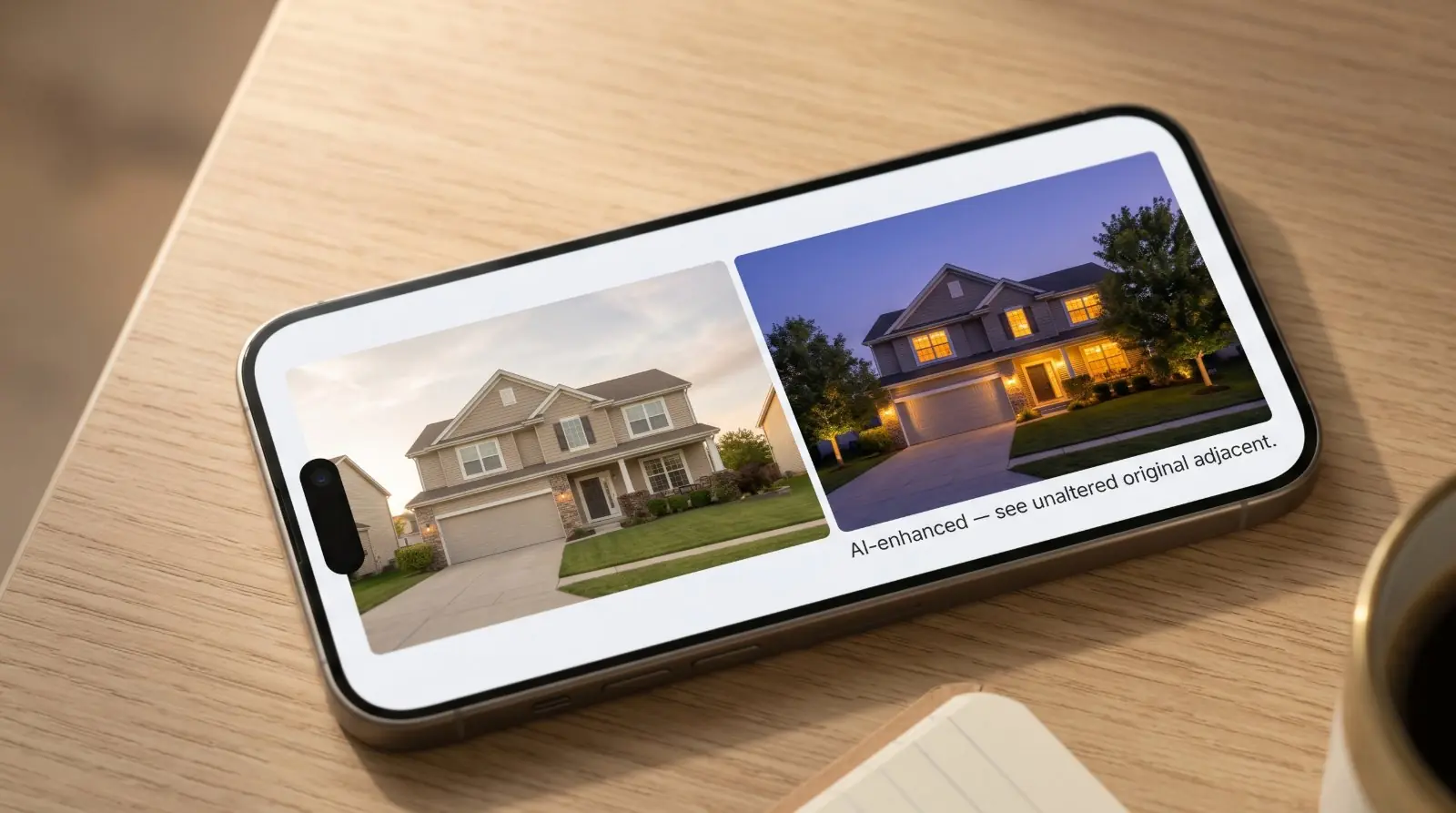
NAR Articles 2 and 12 in plain English
Two articles of the Code of Ethics do most of the work governing how you market a listing. This is the version you can hold in your head.
If you are a REALTOR®, two articles of the NAR Code of Ethics do most of the work governing how you talk about a listing — in writing, in photographs, in advertising, and in the description box on the MLS. Almost every complaint that touches listing photography or marketing goes back to one or both of them.
This is the plain-English version. It is not legal advice. It is the version you can hold in your head walking through a property.
The two articles, the short version
Article 2 — don’t hide or fudge facts about the property.
Article 12 — show a true picture in your marketing.
That’s the spine. Everything else is detail.
Article 2 in plain English
The text: “REALTORS® shall avoid exaggeration, misrepresentation, or concealment of pertinent facts relating to the property or the transaction.”
What it actually means:
- If something is true about the property, you cannot pretend it isn’t.
- If something is true about the property, you cannot make it sound bigger, better, newer, or different than it is.
- If something is true about the transaction — like the listing terms, the seller’s situation, or who else is offering — the same rule applies.
Three examples that get agents in trouble under Article 2:
- The house is on a busy four-lane road. The listing description doesn’t mention it, and the front exterior is shot from a tight angle that hides the road. Concealment of a pertinent fact.
- The kitchen had “new appliances” in the listing description, but two of the four were installed seven years ago. Misrepresentation.
- The square footage is described as “approximately 2,400 sq ft.” The appraisal came in at 2,140. Exaggeration of a pertinent fact.
The test in your head: if a reasonable buyer found this out at the inspection or the walkthrough and felt misled, you may have a Article 2 problem.
Article 12 in plain English
The text: “REALTORS® shall be honest and truthful in their real estate communications and shall present a true picture in their advertising, marketing, and other representations.”
Standards of Practice 12-8 and 12-10 make Article 12 operational for digital — including listing photos, MLS images, websites, social posts, and “internet content” generally.
What it actually means:
- The photo of the property has to look like the property.
- The advertising and marketing have to match the property.
- “Marketing” includes the listing photos, the description, the staging, the videos, the virtual tours, the flyers, and the social posts.
- If you alter a listing photo — staging, sky replacement, virtual furniture — it still has to “present a true picture.” Where it doesn’t, you need to disclose.
Three examples that get agents in trouble under Article 12:
- A wide-angle phone lens used so aggressively that a 12×14 bedroom looks like a 20×25 bedroom on the listing. The viewer’s “true picture” is broken.
- A virtually staged bathroom photo presented without any indication it is virtually staged, where the actual bathroom is half-renovated. Marketing that doesn’t match the property.
- A drone shot showing a lake “across the road” — where the lake is actually across the road and across a 60-foot easement, two private lots, and a public access path that does not belong to the property. The drone picked an angle that misrepresents the property’s relationship to the lake.
The test in your head: would a reasonable buyer arriving at the property be surprised by anything in the marketing that they relied on? If yes, you may have a Article 12 problem.
What “pertinent” and “true picture” leave room for
Both Articles use language that gives professionals room to operate. “Pertinent facts.” “True picture.” Neither phrase requires perfect realism — neither phrase requires that every photo be a forensic snapshot.
Things that are generally fine under both Articles:
- Standard exposure correction, white balance, cropping, straightening. These don’t change the property. California’s AB 723 disclosure law explicitly excludes these as “basic edits.” NAR Article 12 takes the same view.
- Light staging. Adding a bowl of fruit, a vase of greenery, a folded throw on a sofa. Buyers know listing photos are dressed. As long as the staging doesn’t claim a feature that isn’t there (a bowl of fruit doesn’t claim “the kitchen has fruit”), it is inside the line.
- Wide-angle lenses used proportionally. The phone’s standard wide is fine. An ultra-wide shot that bends cabinet faces is not.
- A flattering time-of-day shoot. Late-afternoon side light on the exterior is the same property, just at its best hour.
Things that move into Article 2 / Article 12 territory:
- Removing visible features that exist — power lines, utility poles, the neighbour’s roof, a HVAC unit, a fence.
- Adding features that do not exist — a tree, a pool, a fireplace, a roofline, a view.
- Replacing surfaces — turning a tile counter into a stone counter, turning hardwood into LVP.
- Virtual staging without disclosure in states or MLS regions that require it.
- Composition or editing that materially misrepresents room size, layout, or scale.
The line is drawn at the property itself. Adjust the photograph. Don’t adjust the property.
How this connects to the AI disclosure laws
State law in 2026 is starting to write the Article 12 test into statute.
California AB 723 (Business and Professions Code § 10140.8) is live now. It requires reasonably conspicuous disclosure when AI or digital tools alter the property’s representation in a listing image — added/removed/changed elements of fixtures, furniture, appliances, flooring, walls, paint, hardscape, landscape, façade, floor plans, exterior views — and it requires access to the unaltered original.
Wisconsin Act 69 (Wisconsin Statute § 452.136(1m)) follows in January 2027, with a slightly narrower “creates a false or misleading impression” test.
What this means for the working agent: where state law applies, disclose. Where it doesn’t, apply Article 12 — and disclose anyway when the edit is on the line. The longer version of the disclosure law landscape and how to apply it lives at AI photo disclosure for real-estate listings and Sky replacement and the NAR disclosure question.
The short version
Article 2: don’t hide facts about the property, don’t make it sound bigger or newer or better than it is.
Article 12: the photos, the description, the staging, the video — all have to add up to a true picture of the property.
The test in both cases is the reasonable buyer arriving at the property. If they’d feel misled, you have a problem. If they wouldn’t, you don’t. Most listing photography sits comfortably inside that line. The cases that don’t are usually the cases where the agent already knows the answer.
Sources
- NAR — 2026 Code of Ethics and Standards of Practice
- California Business and Professions Code § 10140.8 (AB 723): leginfo.legislature.ca.gov
- Wisconsin Statute § 452.136(1m): docs.legis.wisconsin.gov
- FTC — Section 5 / AI deception: ftc.gov
- ListedRight — AI photo disclosure for real-estate listings
Don’t adjust the property. Adjust the photograph.
Phone photos to market-ready listing images in 10 seconds. Twenty free when you sign up — no credit card.
One photo tip every Sunday.
Real techniques agents are using this week. No spam. Unsubscribe in one click.