Corners beat doorways — a quick visual guide
The doorway is where the room ends. The corner is where it begins — and shooting from it can make a room read 40% larger.
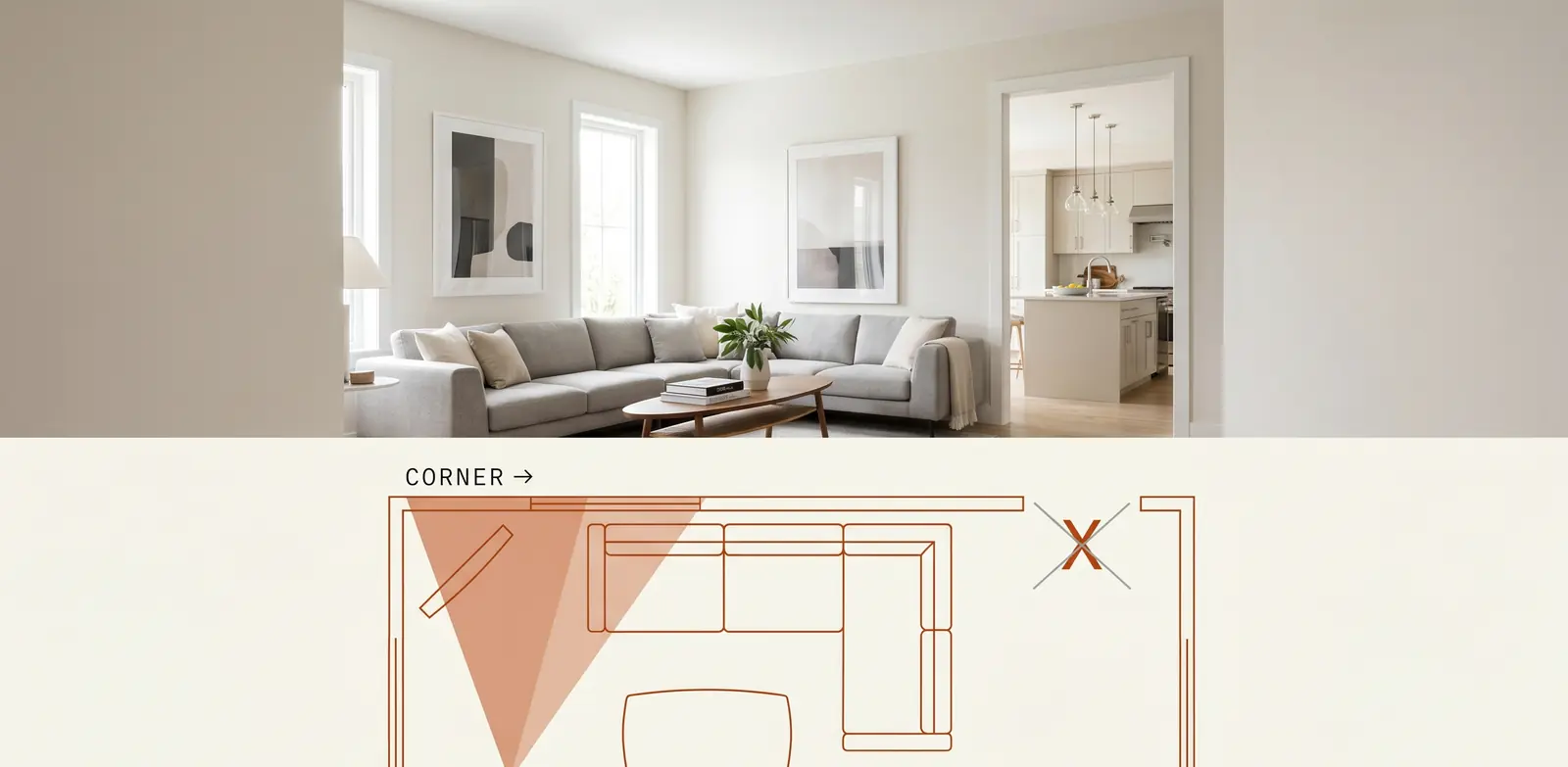
Most agents shoot a room by standing in the doorway and pointing the camera straight in. It feels intuitive. It is also why most phone-shot listings make every room look smaller than it is.
The fix is one step: shoot from the corner, not the doorway. That single change does more for a room’s apparent size than any other technique you can apply at the moment of the shoot.
Why doorways shrink the room
A doorway is, by definition, the narrowest point of a room’s perimeter. Standing there, the camera sees:
- A short distance from camera to the back wall.
- Two parallel side walls converging hard towards the centre.
- Floor and ceiling lines also converging towards the centre.
The eye reads strong central convergence as depth being collapsed, and the room looks like a corridor with stuff at the end. Even a generous living room photographed from the doorway feels narrow on a phone screen.
There is also a secondary problem: from the doorway, you cannot include both a sense of where you are in the layout and a sense of how the room flows to the next room. A corner shot includes both.
Why corners expand the room
A corner shot puts the camera at the apex of the room’s largest diagonal. The camera now sees:
- The longest distance the room offers — corner to opposite corner.
- Two side walls opening outward from the camera, not converging inward.
- The floor and ceiling lines running cleanly across the frame, anchoring the composition.
The eye reads diagonal opening as space expanding. The same room photographed from the corner reads as 20% to 40% larger than it does from the doorway. Nothing in the room has changed — only the camera position.
There is a second benefit. From the corner, you can usually include a doorway, a window, or both, which gives the photo a “next room” cue. Buyers read those cues as flow, which is the single most-discussed quality of a home tour.
The technique
1. Stand in the corner that gives you the longest diagonal. In most rooms, this is the corner opposite the main feature wall — the wall with the fireplace, the headboard, the TV, the range. The feature wall should be visible, but it should not be the wall you are pressed against.
2. Get the camera into the actual corner, not three feet out from it. Move the tripod within six inches of the corner. Every inch you give up between you and the corner costs you angle of view.
3. Keep the phone at chest height — roughly four to five feet off the floor. Higher than that exaggerates the floor and makes the ceiling feel low. Lower than that exaggerates the ceiling and makes the room feel cavernous and unsettling.
4. Use the camera grid to keep verticals straight. A corner shot is the most sensitive composition to a tilted vertical. The two side walls leaning together is the single fastest tell that the agent shot in a hurry. See The four iPhone settings every agent should change.
5. Compose so a doorway or window is visible. This is the “flow cue” — the second-most-valuable feature of the shot. Even a small glimpse of the next room reads as connection and movement.
When a doorway shot is the right call
There are a few:
- Very narrow rooms — bathrooms, walk-in closets, galley kitchens — where the doorway is actually the longest available axis. The room is corridor-shaped, so the camera position has to acknowledge that.
- The connection shot — sometimes the most useful image is the one taken from the doorway looking in, intentionally, to show how a room receives a guest entering it. This is the second shot in a room, not the hero.
- Very small rooms with no usable corner. Some powder rooms and second bathrooms simply do not have a corner the camera can fit into.
But for living rooms, kitchens, dining rooms, primary bedrooms, family rooms, and bonus rooms — the corner shot is the hero shot. Every time.
The 30-second test
Before you tap the shutter from the doorway, look at the screen. Ask yourself two questions:
- Can I see at least one other room or hallway through a doorway or arch? If no, you are too far from a corner.
- Are the two side walls visible in roughly equal proportion, with the back wall framed in the middle distance? If the back wall takes up half the frame, you are still standing in a doorway. Move.
Both rules together produce the same outcome: the camera in a corner, the room opening outward, the layout reading the way the buyer will actually walk through it.
The short version
The doorway is where the room ends. The corner is where the room begins. Stand in the corner. Camera at chest height. Verticals straight. Include a doorway or window so the room flows somewhere. The room will look 20% to 40% larger on the listing carousel, and you will not have shot it twice.
Stand in the corner. Watch the room open up.
Phone photos to market-ready listing images in 10 seconds. Twenty free when you sign up — no credit card.
One photo tip every Sunday.
Real techniques agents are using this week. No spam. Unsubscribe in one click.