How to photograph a basement — finished, unfinished, and the utility room nobody knows what to do with
The hardest interior to shoot in residential listings, and the most under-leveraged. Three types of basement, one lighting problem, and the honesty calculations that separate a basement photo from a misrepresentation.
Basement photos in the typical listing fall into one of two categories: they aren’t there at all, or they’re bad enough that they hurt the listing. Both are mistakes. The market has shifted — buyers now evaluate finished basements as legitimate additional living space, and an unfinished basement that’s clean, dry, and well-presented is a feature, not a liability. Skipping the basement signals there’s something to hide. Including a bad basement photo confirms it.
The honest reasons most agents skip basements: they’re genuinely the hardest interior to shoot. Low natural light, low ceilings, mixed light sources, exposed mechanicals, and a general lack of the visual cues — window light, foreground objects, ceiling height — that make every other room photograph easily. The phone camera is fighting the conditions.
Before the tactical detail, the editorial framing that should sit at the top of every basement shoot: for finished spaces, sell lifestyle. For unfinished spaces, sell opportunity. For utility spaces, sell organisation and accessibility. The job of a basement photo isn’t to document square footage — it’s to help the buyer picture themselves using the space for something specific.
This article covers the four types of basement you’ll shoot — finished living space, walk-out basement, unfinished raw space, and utility/mechanical — what the right approach is for each, the specific lighting moves that turn a basement photo from grey-mud to usable, and the honesty calculations that come with NAR disclosure when you start brightening shadows and balancing colour casts in a space the buyer hasn’t seen in person yet.
The light problem
Every other interior photography problem is downstream of this one. Basements are dim. There’s usually one or two small egress windows providing minimal natural light, ceiling fixtures that are either bare bulbs or recessed cans, and frequently a mix of warm and cool light sources fighting each other for the camera’s attention.
The fundamental moves:
1. Turn on every light. Bring extra light if you can.
Same rule as every other room, but more important here. Every overhead fixture, every recessed can, every lamp, every workshop fluorescent, every utility light.
If the basement is genuinely dark even with every fixture on — which is common — bring portable light. A $25 LED panel from any photography or hardware store, a clip-on work light, even a desk lamp from the floor above. Place it outside the frame, ideally bouncing off a wall or ceiling so the light is diffused rather than direct. One extra light source can lift a basement from “subterranean cave” to “looks like a room.”
2. White balance is going to fight you.
Basement lighting is almost always mixed. Older fluorescent fixtures throw green. Incandescent bulbs throw warm. The egress window throws cool daylight. The phone’s auto white balance picks one and gets the others wrong. Two options:
- — Tap to lock white balance on a neutral surface under the dominant light source. Tap on a white wall or pale floor in the area lit by the most lighting; the phone calibrates the rest of the frame to that reference.
- — Replace the warm bulbs with daylight-temperature bulbs (5000K LED) before the shoot if the seller is willing. Costs $15–30 in bulbs, takes 10 minutes, eliminates the mixed-light problem for every photo you’ll take down there for the rest of the listing.
3. The exposure-lock trick still applies.
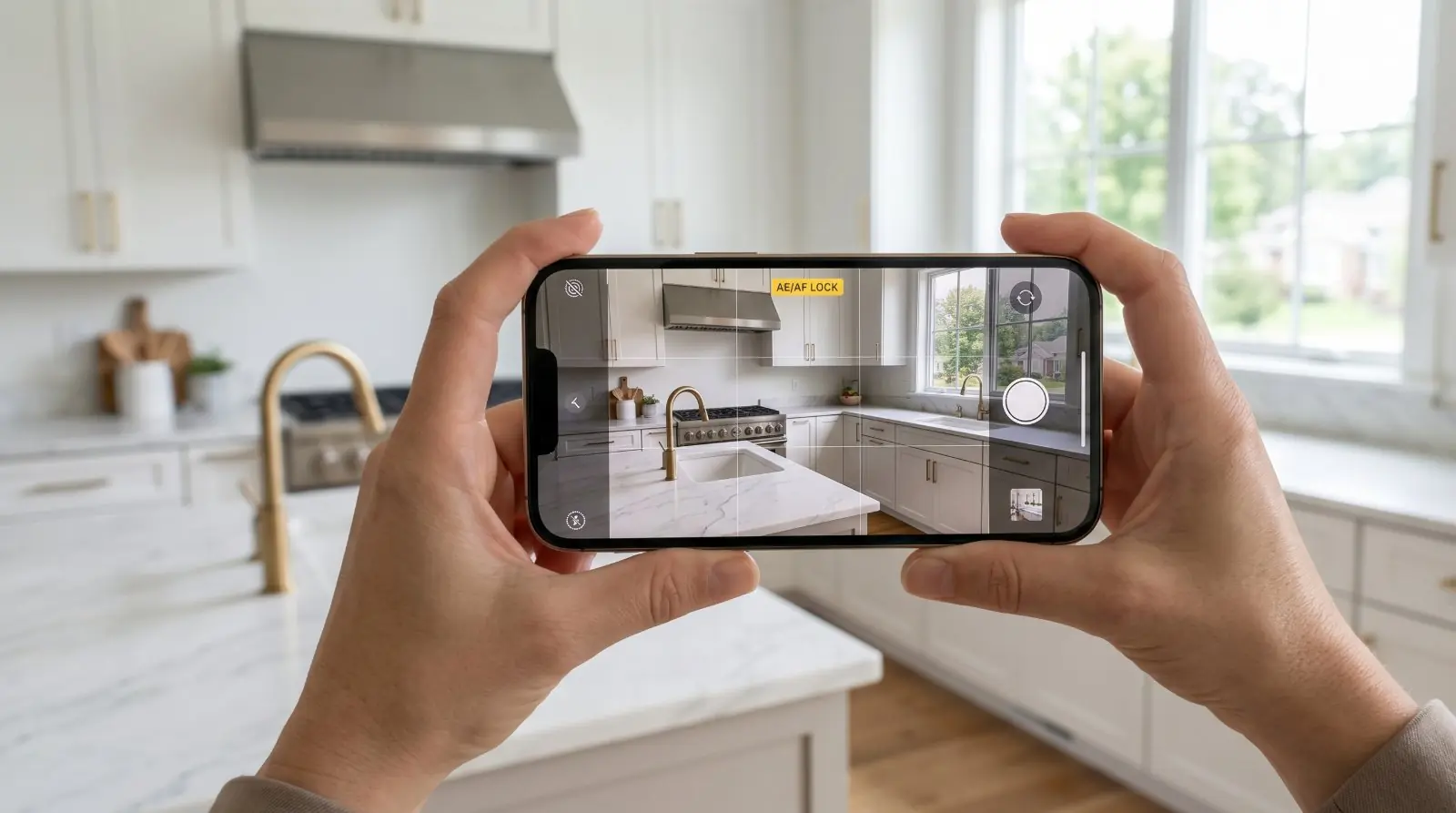
Even in a basement, you’ll often have one bright spot (an egress window, a fixture directly above the camera) that’s much brighter than the rest of the frame. Tap and hold on the brightest area to lock the exposure to it; recompose; shoot. The interior fills in from the lights you turned on.
4. This is one of the few residential scenarios where RAW genuinely helps.
Basements are exactly the high-contrast, low-light, mixed-balance case that RAW capture was designed for. The post-processing latitude on shadow recovery and white balance correction is significantly greater on a RAW file than a JPEG. If you’re going to use RAW on any room of the house, the basement is the room.
The framing problem — low ceilings, no foreground
Basements typically have lower ceilings than the floors above (often 7′–8′ versus the 9′–10′ above grade) and lack the foreground anchors — counter edges, doorway frames, window sills at body height — that make composition easy in other rooms. Two adjustments:
1. Lower the phone.
Most rooms get shot at chest height (48–54″). For a basement with a low ceiling, drop to waist height (around 38–42″). The lower angle makes the ceiling read taller and includes more of the floor as a foreground anchor. A mini-tripod helps lock this consistently.
2. Be careful with ultra-wide.
The 0.5× ultra-wide lens makes small rooms read larger, which is the temptation. The problem: in a low-ceiling basement, the ultra-wide distortion bows the ceiling line and stretches the room in ways that read as fake. The buyer arrives at the showing and feels the ceiling is much lower than the photo suggested — the kind of small mismatch that erodes trust across the entire listing.
Use the standard 1× lens unless the room genuinely can’t be captured at all without ultra-wide. If you do use ultra-wide, stand further from the back wall than feels right; the distortion is worst at the edges of the frame.
3. Make the foreground work.
In a finished basement, a corner of the sectional, the edge of a coffee table, a stool at the wet bar — these become the foreground anchors. In an unfinished or utility basement, the foreground may have to be the concrete floor itself; in that case, get the foreground floor lit (sweep, mop if needed) so it doesn’t read as a dark void.
Shooting a finished basement living space
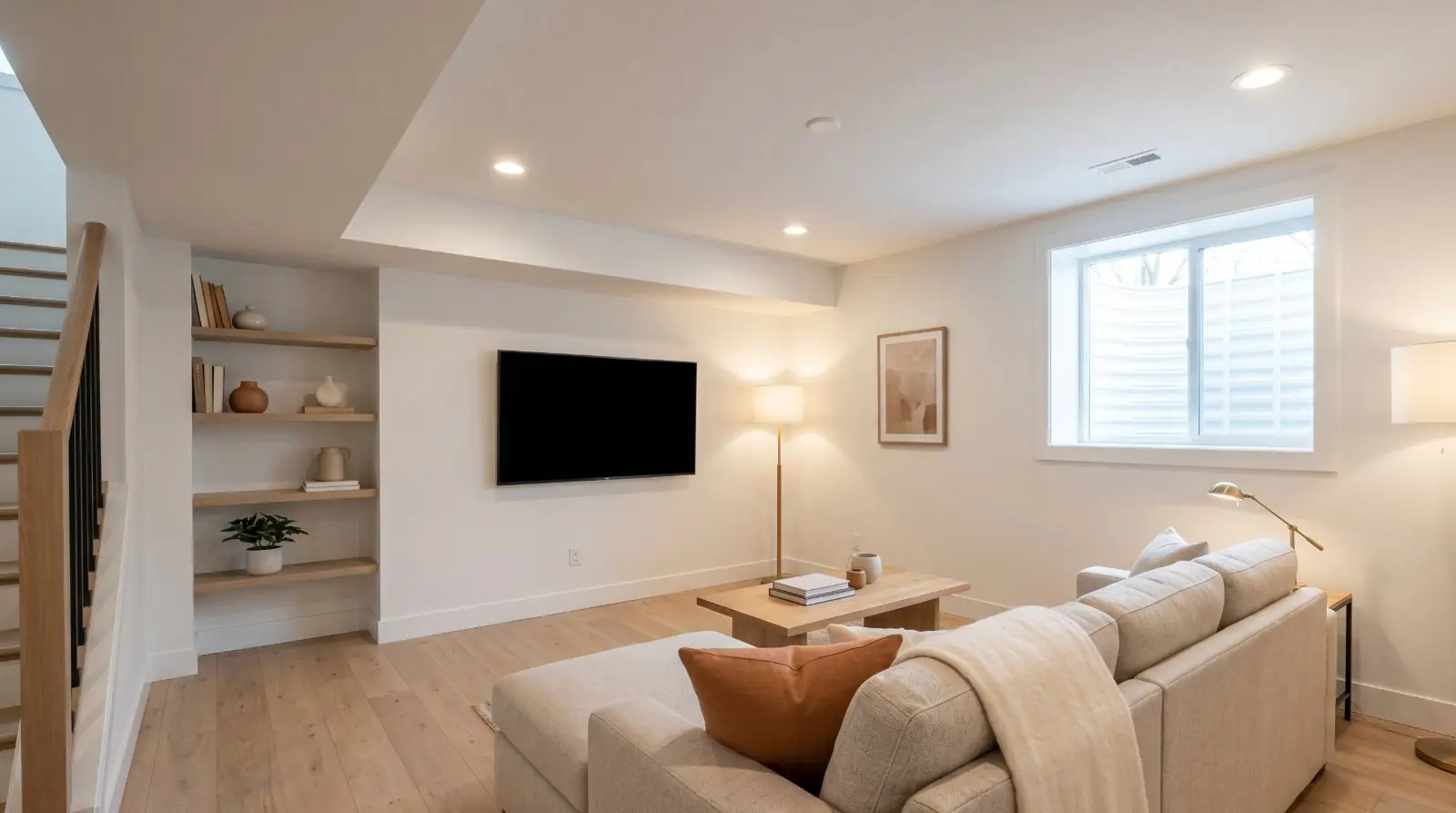
Treat it like the room it functions as. A finished basement family room is a family room — photograph it with the same approach you’d use for an above-grade family room. The job of the photo is to communicate that this is legitimate living space, not just “below grade.”
The moves:
- — Lighten everything you can. Pull back any heavy curtains on the egress windows. If the floor is dark, consider whether the seller has a light-coloured area rug that could be brought down for the shoot.
- — Stage as you would any living space. One or two intentional styling items — a folded throw, a stack of books, a single decorative object.
- — Show the egress windows. Even if they’re small, including them in the frame signals “this is legitimate finished living space with natural light.”
- — Show the ceiling height honestly. Don’t shoot from low enough that the ceiling reads dramatically higher than it is.
- — Capture the connection to the rest of the basement. If the family room opens to a bar, a workout area, or a flex space, the connection shot tells the buyer the basement is a flowing additional floor, not a single isolated room.
Activity zones, not one undifferentiated rectangle
Most finished basements aren’t one room — they’re a flexible space hosting multiple functions. A lounge corner with a sectional. A workout area with a treadmill against the wall. A wet bar. A small home office tucked into one end. The buyer wants to know how the basement works as a daily living space, which means the photos have to communicate the zones.
Two implications for shooting:
- Don’t try to capture the whole basement in one shot. A wide shot of a 1,200-square-foot finished basement reads as empty space with furniture floating in the middle. The buyer sees the size but doesn’t see the function.
- Shoot each zone as its own composition — the lounge area as a “this is the family room” shot, the workout zone as a “this is the gym” shot, the bar as a “this is the entertainment area” shot. Three or four zone-focused shots tell the basement’s story better than two wide-angle shots that try to do everything.
The connection between zones still matters — at least one shot should show how two adjacent zones flow together. But the centre of gravity is in the zone-specific shots.
Help the buyer imagine the specific use
The strongest finished-basement listings communicate what the space could be alongside what it currently is. Common uses the buyer might be evaluating:
- — Family room or media space
- — Home theatre
- — Home gym
- — Home office (or his-and-hers offices)
- — Guest suite or in-law space
- — Playroom for younger kids, hangout room for older kids
- — Wet bar and entertainment zone
- — Workshop or hobby space
- — Wine cellar or wine storage
- — Au pair / rental suite (where local code allows)
The seller may use the basement as one of these; the buyer may use it as another. The photos that work are the ones flexible enough to let the buyer imagine their use. A heavily-themed basement photographs as “this is what the current owner did” rather than “this is what I could do.” When the seller is willing, lean toward neutral staging that lets the imagination work.
Capture the features
Most finished basements have one or two specific features the listing is selling. Each one earns its own shot when it’s strong enough:
- — Wet bar — straight-on or slight three-quarter angle, every fixture lit, glassware staged but minimal, bottles tidy.
- — Fireplace — fire lit if possible, photographed straight-on or with a partial corner angle.
- — Built-ins (bookshelves, media units, custom millwork) — doors closed or partially open to show storage, styled but not crammed.
- — Home theatre setup — projector and screen if there is one, screen showing a neutral image.
- — Wine cellar or wine storage — interior view if there’s a dedicated cellar; wine fridge integrated into the bar if it’s just storage.
Basement bedrooms — the egress conversation
A bedroom in a basement is only legally a bedroom if it meets the local code for egress windows: a window opening of sufficient size and accessibility for a person to exit (and a firefighter to enter) in an emergency. The IRC standard most US municipalities follow:
- — Minimum opening: 5.7 square feet
- — Minimum height: 24 inches
- — Minimum width: 20 inches
- — Sill height: no more than 44 inches above the floor
Some states and local codes vary. Always check the listing’s permits and the seller’s documentation before describing a basement room as a “bedroom.”
For the photo: include the egress window prominently in at least one shot. Caption or note in the listing description that the bedroom is “code-compliant egress.” Avoid framing a basement room as a “bedroom” in the listing if you’re not certain it meets code. Describe it as a “flex space,” “office,” “5th room,” or whatever the seller and your broker agree on. Misrepresenting a non-conforming room as a legal bedroom is the kind of thing that becomes a complaint to the state real-estate commission.
Walk-out basements — a different problem entirely
A walk-out basement is technically still a basement, but the shooting problem is almost the opposite of the rest of this article. A walk-out has full or near-full glass on one wall (the side facing the slope of the lot) plus door access to grade — meaning the lighting situation is more like an above-grade living space than a typical below-grade basement. Bright daylight pours in from one side, the room is genuinely well-lit, and the buyer’s mental model is “garden-level living space,” not “basement.”
The lighting problem inverts. Instead of fighting darkness, you’re often fighting the contrast between bright glass and the rest of the room. Same exposure-lock situation as any other glass-heavy interior — tap and hold on the brightest area of the glass to lock exposure, let the interior fill from the lights you turned on, recompose, shoot.
The composition opens up. With one wall effectively serving as a window wall, you have a far better range of angles to work with. The “shoot from the corner farthest from the windows” rule from interior photography applies straightforwardly. The connection between interior and exterior (the patio, the garden, the slope of the lot) becomes a feature worth shooting deliberately.
Sell the indoor/outdoor flow. The single strongest signal a walk-out basement can send is that it functions as both an interior living space and an outdoor entertaining space. At least one photo should include both — shoot from inside the basement through the open sliding doors, showing the patio or garden visible beyond. This is the shot that separates “walk-out basement” from “regular basement” in the buyer’s mind.
Show the exterior elevation. A walk-out basement has an exterior face that most buyers won’t have seen from the front-of-house shot — it’s typically on the back or side of the property, exposed by the lot’s slope. Include at least one exterior shot of the walk-out face from the yard, showing the door access, the windows, and the relationship to the outdoor space.
Daylight scheduling matters. Because the glass wall is the dominant light source, the time of day affects walk-out photography more than other basement work. Avoid midday direct sun blasting through the glass (it blows out the exposure and casts hard interior shadows). Best window: late morning to early afternoon on a bright overcast day, or late afternoon to early evening when the light is lower and more directional.
For high-end walk-outs, twilight earns its place. A luxury walk-out basement with warm interior lighting and a deep blue exterior sky behind the glass wall is a strikingly effective shot. The day-to-twilight rendering approach applies here just as it does to the exterior — shoot in daylight, render to twilight, disclose the edit.
A note on luxury basements
Luxury basements ($1M+ listings with finished basements approaching 1,500–3,000 sq ft, often with 9′+ ceilings, full kitchen, wine room, gym, home theatre, guest suite) get treated as additional above-grade-quality living space. Same standards, same lighting expectations, same restraint as the rest of the luxury listing’s photography. The basement-specific issues (mixed light, low ceilings, dark corners) are largely absent at this tier — the basement was designed as living space from the start, often with the same finishes as the floors above.
For these listings, ignore the “low ceiling, drop the phone to waist height” advice — shoot at the same chest-height standard as the rest of the home. Ignore the “minimal styling” advice — a luxury basement gallery benefits from the same level of styled-but-not-cluttered presentation as the main living space. And do consider twilight rendering of the walk-out shots if there’s strong glass-wall geometry.
Shooting an unfinished basement
The hardest type, and the one most agents skip. The instinct to hide an unfinished basement is wrong — buyers in 2026 know that unfinished basement = future-finished space, and they actively look for evidence that the unfinished basement is worth finishing. A clean, well-presented unfinished basement is a positive signal.
The presentation moves:
- — Clean it. Sweep the floor, dust the framing, knock down cobwebs in the corners, remove the seller’s storage boxes (or relocate them neatly to one corner).
- — Show that it’s dry. Lighting matters here — a bright, well-lit photo signals “no moisture issues.” A dim, shadowy photo lets the buyer assume the worst.
- — Show the ceiling height. Buyers want to know whether the unfinished basement is genuinely finishable. Include enough of the ceiling in frame that the height is readable.
- — Show one frame that reads as “this could be a finished space.” Stand at one end of the basement and shoot toward the other end, ideally including a view through to where future walls or rooms could go.
- — Capture the foundation walls and visible structure honestly. Poured concrete foundation walls in good condition are a feature in modern listings. Show them.
Shooting a utility / mechanical space
The room most agents skip entirely. There’s an argument for that — a furnace and a water heater aren’t visually exciting — but there’s a stronger argument for including one or two utility-space photos in the gallery: in 2026, buyer’s agents (and home inspectors) increasingly use the listing gallery as a preliminary check on the property’s systems. Showing the utility space well says “we have nothing to hide.”
1. Capture the panel, the furnace, the water heater, the sump (if there is one).
One wide shot showing the layout of the utility space. The viewer should be able to see: the electrical panel (or panels); the HVAC / furnace; the water heater; the sump pump (if present); the main water shut-off (bonus). For larger utility rooms, this might be two shots.
2. The “this is organised and accessible” signal.
The job of a utility-room photo is to communicate that the systems are accessible, maintained, and well-organised. Sweep the floor and pick up clutter. If the seller stores items in the utility space, relocate them neatly or to another room for the shoot. Coil any visible loose cords or hoses. Make sure the panel cover is closed and clean. Brush off cobwebs.
3. Note the system ages or recent updates in the listing description.
The photo is the visual; the listing description is where you put the facts. If the furnace was replaced in 2024, say so. If the water heater is new, say so. The combination of a clean utility-room photo and a “systems updated within last 3 years” line in the description is among the strongest credibility signals you can put in a listing.
4. Laundry rooms get treated as their own space.
If the laundry is in the basement, it gets its own shot. Standard treatment: every light on, surfaces clear, washer and dryer fronts wiped clean, no clutter on top, ideally an angle that includes any cabinetry or counter space.
What to leave out
The basement-specific add to the standard remove-from-the-frame list:
Where basements go in the listing gallery
Basements aren’t first-six photos — those slots belong to the front exterior, main living space, kitchen, primary bedroom, primary bath, and standout feature. The right placement for basement photos in the gallery:
- — Walk-out basement: higher than agents expect. If the indoor/outdoor flow is strong, the best walk-out shot can earn slot 6–10. The walk-out exterior elevation shot belongs in the exterior cluster.
- — Finished basement living space (standard, non-walk-out): slot 10–14 range. If the finished basement is a clear standout feature, it earns a higher slot.
- — Unfinished basement: slot 16–20 range. Late in the gallery. The buyer who scrolls this deep is qualifying the property.
- — Utility / mechanical: slot 18–22 range. Often the last interior shot in the gallery. One photo is enough.
How many basement photos: a small unfinished basement — one wide shot, maybe a second of the utility area. A finished basement with one or two functional zones — 2–3 shots. A fully finished walk-out basement with multiple rooms — 5–7 shots, treating each space as you would the equivalent above-grade room. Don’t pad. A boring basement photo dilutes the gallery; a missing basement photo just makes the buyer’s agent ask.
A note on regional differences
Basement prevalence varies dramatically by region. The Northeast, Midwest, and Mountain regions are basement-dominant — most single-family homes have full or partial basements. The Sunbelt (Florida, Texas, Arizona, the deeper South) is largely slab-foundation, with basements rare or non-existent.
If you’re a Sunbelt agent who occasionally lists a property with a basement, the unfamiliarity is itself a small wedge — the photos need to do more work because your local buyer pool is less practised at evaluating basement space. Lean into the brightness and the cleanliness; minimise the cave-like signals; show the egress windows and ceiling height clearly.
Brightness, shadow recovery, mixed-light balance, all in one pass.
Phone photos to market-ready listing images in 10 seconds. Twenty free when you sign up — no credit card.
One photo tip every Sunday.
Real techniques agents are using this week. No spam. Unsubscribe in one click.